October 12, 2012

Hooray for Europe!

Romania, 1976 - I was shorter, but Communism was big.
Many of my friends on this side of the Atlantic (and on the other side of the Mediterranean) have reacted with derision and ridicule to the news that the European Union is receiving this year's Nobel Peace Prize. LOL, haha, gimmeabreak, etc.

Here are a few of my own reactions:

THIS ISN'T FUNNY

The eurozone is currently suffering through potentially catastrophic economic turmoil. While there were definite structural flaws in the new economic integration, and the major EU players have exacerbated matters by reducing rather than expanding short-term liquidity, the major crisis was triggered by our own financial brinkmanship and near-collapse here in the United States: The CDO and mortgage bubble, Lehman Bros, trillion-dollar budgetary black hole in Iraq and Afghanistan -- and much more. There's nothing funny about Europe's current woes in any case, especially given the increasing connectedness and see-saw dynamic between our two mega-economies, and the history of instability over there eventually costing Americans our own blood and treasure.

EUROPEANS ARE THE GOOD GUYS

In a world that's increasingly out of balance -- and with violence and uncertainty flaring across the Middle East, the EU has been our key partner in promoting stability and progress. Its member states also comprise the bulk of our NATO allies. We should be wishing them well, and doing whatever we can to encourage and support them, not tear them down and poke fun.

MAYBE THEY DO DESERVE THE NOBEL PRIZE

When Alfred Nobel conceived of his peace prize, he wasn't thinking about ending conflicts in East Asia or Central Africa -- he was focused on Europe. The EU s the embodiment of many of those hopes and aspirations -- as the Nobel Committee put it:

The work of the EU represents "fraternity between nations", and amounts to a form of the "peace congresses" to which Alfred Nobel refers as criteria for the Peace Prize in his 1895 will.

EUROPEAN UNITY MATTERS

All those childhood summers spent bouncing around Europe during the 1970s involved no end of cumbersome border crossings between East and West, within the Communist Bloc, and even between some of the Western European democracies. Borders and virtual barriers were very evident, and not only because of the Soviet domination over half the continent. Europe's divisions went back centuries and the animosities were still very fresh. Indigenous Muslims and Gypsies were barely tolerated, if at all. And of course, the despair, privations and terror of Communist rule were as overwhelming as they were implausible. And it was all very real. Just visiting Berlin today is an out-of-body experience, as the once stark dividing line remains only as a course of paving stones, a short segment of the old wall, and memorial markers where East Germans were killed attempting to cross into freedom. The very idea of East Germany or exit visas seems so remote, and yet 25 years ago it was a reality.

ENOUGH IS ENOUGH

Perhaps, as Americans living in the here and now, we measure the world too much by what we -- not others -- have achieved recently, rather than in any other generation. The challenges we face today can blind us to the struggles of every other nation, forgetting that the post-9/11 mirror poles used to check for bombs under our cars were once used in Berlin to stop East Germans from escaping between the axles.

As early as 1821, Thomas Jefferson wrote to John Adams: “Even should the cloud of barbarism and despotism again obscure the science and liberties of Europe, this country remains to preserve and restore light and liberty to them.” Such arrogance and exceptionalism have been among our greatest flaws and most powerful of inducements to keep pushing forward and saving the world. But this week, a little humility is in order, and yes, some appreciation for the dedication, aspirations and achievements of others -- especially those we call our friends.

October 11, 2012

Israel's elections lead to fewer choices

No one can be surprised that Israeli Prime Minister Netanyahu has called for elections early in 2013, months ahead of the legal deadline. It's less common that Israel's faction-based political arena is static enough for everything to happen on time.

One key difference between Netanyahu and U.S. President Barack Obama relates to our different political systems: Each morning Netanyahu awakes in the PM's residence, his number-one goal for that day is to go to bed at the end... in the PM's residence. For Obama, on the other hand, regardless of how many circles a mid-level ally runs around him, each day he knows he'll be returning to sleep in the White House. This allows him to think a bit more expansively about the opportunities and challenges facing America and the world.

For Netanyahu, as for most of his predecessors, his primary calculation has centered on maintaining and increasing his personal political power and influence. Years ago, he was the leading advocate for direct election of the Prime Minister, figuring it gave him the best chance to get in over the heads of seniority-based faction leaders within the Likud Party. And he was right -- though the flawed process, which retained a Knesset's component, evoked Churchill's maxim about trying to cross the abyss in two steps.

Netanyahu has had to share the spoils of his office with people he dislikes -- politicians like Foreign Minister Avigdor Lieberman on the right and Defense Minister Ehud Barak on the left. Barak has stayed on despite abandoning his own party affiliation, largely as a useful check against Netanyahu's many rivals within Likud and Israel's broader, growing right wing. Truly, his is a government of enemies.

Having pumped up the twin threats of Iran and Obama as much as possible -- against a backdrop of Arab Spring, summer, and fall -- Netanyahu is well-positioned to pick up extra seats and toss out a few of his hangers-on. Domestic issues like perennial religious and budget priorities are also in play. And so is former-PM Ehud Olmert, not quite exonerated but mostly cleared to return to politics.

The only aspect that might have been surprising -- Netanyahu's contention that the dangers facing Israel demand a clear decision by the Israeli electorate -- is also no surprise, given the way he has inflated the specter of Iran (and, yes, of Obama) to the brink of irrelevance. This was demonstrated by his recent "eh, never mind" United Nations speech, which pushed off any urgency on Iran's nuclear program until next spring at the earliest and also fell in line with President Barack Obama's consistent strategy and perspective.

Regarding the Palestinian issue, Netanyahu has obvious ideological reservations about making any substantive concessions. As a side benefit, the longer Israeli-Palestinian tensions fester and flare, the less invested Israeli voters feel in any effort for a long-term solution -- and the more they rally around a bunker-mentality leader like Netanyahu.

Having lived in the States for a number of years, Netanyahu is well aware of our own forthcoming elections. And one televised debate notwithstanding, he's a bit worried that Americans will re-elect the current President. So Netanyahu needs to appear both conciliatory toward Obama and secure back at home. Being re-elected as Prime Minister -- and without Lieberman or Barak pulling him down and cutting their own side deals -- will be the perfect formula.

October 3, 2012

Nothing ever happens on my block

On our latest visit to my folks, in the same house where I grew up, I finally met some of the new families who've been restocking that quiet suburban block with young kids, after three decades of mostly adult living. They hold block parties and July 4th parade activities, and generally hang out on the street at the end of a day. Great!

One of the houses still devoid of young kids is where Andrew grew up. He was a couple of years younger, and we'd sometimes visit each other for what today would be called "play dates", We also just ran around the neighborhood, climbing trees and filling afternoons with forgotten pastimes.

I hadn't seen or heard of Andrew in probably 25 years, but last month the talk on the street was all about him. Turns out, this smart kid with the strange father and quiet mom had lived out his adult years as a criminal, including an 18-month stint in prison. Then finally, he got himself into a police chase after the stolen SUV he was driving clipped another car waiting to get past an accident scene. On a secluded path between the train tracks and the Schuylkill River, not far from where I learned to windsurf, he ambushed the officer -- an Iraq veteran and father -- with his Beretta. Before dying, the officer returned fire, hitting Andrew. My former sometime playmate, who reportedly had told friends he'd never go back to jail, then shot himself in the chest, ending his unfortunate and evidently miserable life. 

The fallen Marine is a huge tragedy for the community and his young family, and the first fatality for his township's police force. 

For myself, it's sobering to think what if any decisions and influences might have altered the course of a self-centered only child with little patience for wrong answers. It's far-fetched to think any of us growing up there should have done anything to intervene -- who stays in touch, anyway? I do feel a special burden and even guilt, just for having briefly been part of his circle on a small street with two-dozen homes. And instead of the old man who'd designed the ejection seat for the Navy (the late Mr. Castleman), we'll now be known locally for the murder-suicide hoodlum who lurked among us.

Andrew's mother was already not well, and he'd been living at home. His web cam still faces down on the street from a second-floor bedroom -- which freaks out the neighbors. But they're definitely relieved that he's no longer around, especially with a whole new young generation to raise and nurture. And none of the young parents seems strange at all, thank goodness.

The quiet block where we're raising our own kids is not so different -- families with young kids living next to longtime residents who now boast grandchildren -- and, so far, no violent criminals. 

Dedicated to the memory of Officer Bradley Fox, Plymouth Township Police. Rest in Peace.

September 30, 2012

Netanyahu's 'hurry up and wait' moment

I have a few observations on Israeli Prime Minister Netanyahu's speech last week to the United Nations General Assembly:

1. Had the Prime Minister delivered the exact same speech to the annual banquet of any major Jewish organization or to the Israeli Knesset... well, maybe he already has. In fact, as usual, the target audience for his UN speech seems to have been Israelis and Jews around the world. The world leaders and diplomats sitting in the GA Hall were really just props, or better, foils so he could be seen "talking truth to power". Brilliant, if no longer original.

2. Netanyahu implicitly ceded the peace process discussion to the Palestinians, whose leader Mahmoud Abbas understandably focused his GA remarks on the Israeli-Palestinian issue. His only reference or rebuttal to the Palestinians was a brief nod to the concept of a negotiated solution and uniting the three great faiths.

3. By eclipsing the peace process with his usual lecture on medieval barbarians and clash of civilizations, and -- lest we forget -- the Holocaust -- Netanyahu allowed no hint that Israel is interested in substantively addressing the Palestinian issue. The message to European governments, and to the Russians and Chinese, is that their interest in regional stability can only be satisfied by helping Israel stop Iran. And Israel makes no promises after that.

4. Netanyahu's speech underscored the sense of many around the world -- including decision-makers whose support Israel and the United States still need -- that a nuclear Iran is an Israeli issue more than a global concern.

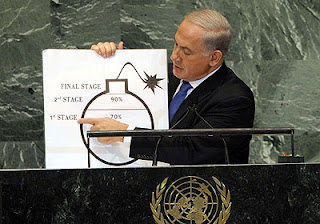
5. Forget the cartoon bomb that's generated so much buzz. The real last-minute prop in Netanyahu's speech was his notion of red lines for stopping Iran. It used to be that Iran had to be prevented from reaching "breakout capacity" -- the point at which it could continue to produce a weapon on its own. Then there was the "zone of immunity" -- the point at which Iran could continue its program without vulnerability to an aerial attack. Now the "red lines" connote the point at which Iran has enough highly enriched uranium to produce its first bomb ("90%") -- leaving a window as narrow as a few weeks (according to Netanyahu). Let's forgive the Obama administration for not updating its policy language fast enough to keep up with Netanyahu's moving goalposts and changing labels, but it now appears that all the hype was just that -- Netanyahu's red lines just happen to correspond neatly with longstanding U.S. policy. Or, as Netanyahu's people have phrased it, President Obama now agrees with the Prime Minister. Smooth...

6. One more shifting benchmark is the effectiveness of sanctions, which until last week were being downplayed by Netanyahu as largely ineffective. But after a phone chat with President Obama, and the leaking of his government's own report that international sanctions are actually having a great impact on Iran, his speech encouraged governments to continue pushing the very sanctions and diplomacy that his minions have been ridiculing.

7. The speech built up to a crescendo of apocalyptic doom and urgency, only to finish with no clear steps for implementing his red lines. After months of spiraling rhetoric and reports about the immediacy of the Iranian threat and the likelihood of an Israeli attack -- including widespread speculation as to whether such an attack would be delayed until after Madonna's summer concert -- Netanyahu pushed off any attack until the middle of next year, at the earliest. For those who honestly believe that next summer will already be too late to stop Iran, Netanyahu's speech was a blatant act of betrayal. The rest of us will have to scratch our heads and try to get back to serious business, which includes stopping Iran's nuclear program.

"It is a tale told by an idiot, full of sound and fury, signifying nothing." -- Shakespeare, Macbeth.

September 27, 2012

I don't hate Netanyahu, but I'll speak my mind.

One of my friends has expressed his sincere perception that I "really don't like" Israeli Prime Minister Netanyahu. Here was my response:

"I like leaders who actually lead rather than play parlor games and keep giving essentially the same UN speech year after year. You've read my blog posts, where I try to explain the reasons for my disappointment. Unlike in U.S. politics, I have no dog in the fights between Likud and its flailing competition -- it hurts me to see Israel missing the boat and focusing on form over substance, especially when the stakes are so high."

Here is my more general explanation of why I criticize the elected leader of Israel and his actions:

I do want Prime Minister Netanyahu to succeed. But success for him seems to be muddling through just enough to shore up his domestic base and core of support in the United States, while kicking the can down the road -- to paraphrase Mitt Romney. For me, that's a recipe for long-term disaster. When the opportunity has presented itself once or twice over the past few years, with the certainty that my comments would be conveyed directly to the PM, I eagerly provided suggestions that I thought would advance Israel's standing with the White House and the international community. Earlier this month, I blogged against his plan to admonish the United Nations General Assembly TODAY regarding Iran -- if you're curious, please read my reasons here.

In 1988 with PM Shamir -- still keeping my thoughts to myself.
Ten years ago, I felt constrained by my professional obligations from publicizing my concerns about invading Iraq (we were busy lobbying the Bush White House at the time). I shared with a small circle of friends and colleagues my certainty that (1) invading Iraq would embolden and strengthen Iran, thereby making Israel less secure; (2) it was highly unlikely Iraq could have MORE weapons of mass destruction than it did BEFORE the decade of sustained embargoes and sanctions; and (3) even if Iraq really were building weapons of mass destruction, the Bush administration was lying that it had credible evidence.

So I kept quiet back in 2002 and 2003, and just months later, publications like The New Republic were wondering how everyone could have been so wrong. I decided that -- if I could -- going forward I would be on record about my analysis and warnings. Not that my views will ever make headlines, but for my own self-respect, to give my own circle an opportunity to include my opinions in their own calculations, and perhaps to impact the politics and policy process. At the very least, my silence will not serve to empower the personal and political agendas of those with whom I disagree.

For many years, I did my best to reiterate and promote the official policies of the Israeli Government, but then I realized that so many champions of Israel -- on the right and the left -- were using the Jewish State to advance their own ideological agenda in Israel and to score partisan points in U.S. politics. When I found myself free to speak my mind, thanks to politicized personnel decisions, I decided to seize the moment for as long as I could.

Back to the original question: I don't especially like or dislike Prime Minister Netanyahu, though I would always give him my best advice with the goal of helping him make the most of whatever situation he chooses to seek for himself and for Israel. In the meantime, I will continue to speak my mind and try to listen to other views along the way.

September 23, 2012

Hello, World? Meet Israel, the Victim State.

As world leaders gather in New York for the annual opening of the United Nations General Assembly, the Israeli Government and Jewish organizations have pulled off a great feat: a quasi-official UN event focused on the Jewish refugees from Arab countries, most of whom were expelled from their homes in the immediate aftermath of Israel's 1948 founding. This big diplomatic breakthrough follows on the UN's first-ever official Holocaust commemoration, back in 2005.

Surely, this was a coup for Israel in its diplomatic score-keeping against Iran, the Palestinians and the Arab states, but how does this help the Jewish State on a world stage, as embodied in the UN General Assembly opening?

Israel stands for so many achievements, cultures, aspirations and industry -- and what it chooses to show the world is martyrs and victims? The Holocaust remains unique in terms of its focus, scale, and ingenuity. Unfortunately, our world has since eclipsed the Holocaust's depravity and numbers of dead, but the Holocaust -- while not Israel's most forward-looking message -- rightly demanded inclusion in the UN's pantheon of historic events and founding lessons, appropriately devoid of political overtones.

This latest UN event has trivialized the Middle Eastern victims thanks to its explicit "me too" purpose of matching any Palestinian grievances with Jewish counter-suffering. Anyone following the daily massacres in Syria and elsewhere might be wondering why the suffering of onetime Jewish refugees should rival that of present-day Palestinians, Somalis, Libyans, or Sudanese (some of whom are now facing mob violence, detention and deportation...in Israel). What universal lesson can be applied from this experience: That Jews can also be victims (yet again)?

Israel ranks as a major world player in medicine and science, technology, democracy, humanitarian assistance and development, economics, and so many other fields. Its leaders are routinely consulted by their counterparts across Europe and Asia on a host of pressing issues... or at least they used to be.

It certainly stands as a tribute to the Middle Eastern Jews who endured suffering and dislocation so many years ago, and they have every right to seek maximum exposure and recognition. But Israelis and Jews at large need not have made this our opening pitch, underscoring our collective weakness and shared suffering (a classic anti-Semitic image, by the way) rather than our vision for a better world and a better region.

Like so many other enterprises these days, I get the sense that Israel's government arranged this latest promotion because it was able to do so, not because it was the best way to advance Israel's interests. Or maybe we've all just run out of ideas.

September 12, 2012

Rushing to blame, Romney disgraces us all

The attacks on U.S. diplomatic missions in Egypt and Libya have reinforced the sense of danger and uncertainty in the Middle East, and should spark a renewed -- and ideally bipartisan -- about how the United States can continue to repair its influence and effect lasting stability in this often chaotic region.

Even before we could know the extent of brutality and barbarism involved in the lynching of U.S. Ambassador Chris Stevens -- let alone all the other facts and factors involved --  the Republican Party Chairman and the Republican nominee for President were rushing to blame President Obama's "failed" policies for these outrageous assaults on the honor and person of American diplomacy.

Leading the pile-on were many of my friends from the right wing of the Jewish, pro-Israel community. Had Obama only listened to Israeli Prime Minister Benjamin Netanyahu, and shown him more respect while showering Israel with unprecedented military support and security cooperation, none of this would have happened. Ironically, this came hours after the eleventh anniversary of the September 11 attacks -- despite President George W. Bush's uncompromising and single-minded campaign against Saddam Hussein. Even more ironically, these attacks came nearly a year to the day since Israel's own ambassador to Egypt was nearly lynched by a Cairo mob -- and only saved through the personal intervention of... President Obama. What a way to say thank you.