Showing posts with label Holocaust. Show all posts

April 23, 2017

Trump has no credibility to pledge "Never again"

It has been reported that President Trump will address Tuesday's "Yom Hashoah" Holocaust commemoration at the U.S. Holocaust Memorial Museum. In addition to Holocaust exhibits and documentation, the Museum very consciously houses the Committee on Conscience and the Center for the Prevention of Genocide.

Today, addressing the World Jewish Congress via video, he pledged, "We must stamp out prejudice and anti-Semitism everywhere it is found." And finally, months after his White House denied the need to mention Jews in connection with the Holocaust, he did mention Hitler's six million Jewish targeted victims. But his rhetoric is very thin on anti-Semitism and the Holocaust, and ignores his administration's consistent refusal to act in support of contemporary victims of mass killings and of racial and religious persecution, even while he and his aides routinely appeal to Islamophobia and other forms of xenophobia here in the United States.

Unless he announces that he's abandoning the border wall, dropping the arbitrary ban on refugees and certain Muslim states, and firing the "Alt-Right" white supremacists and the second-generation card-carrying Nazi working inside his own West Wing, anything he says there can be nothing more than a desecration and betrayal of the memory and lessons of the Holocaust. Singling out Jews for special recognition and protection, while actively sowing fear and hostility toward so many other minorities, does us no favors.

February 19, 2017

If neutrality was a sin during WWII, what is acquiescence today?

Observing the unfolding dystopia known as President Trump's immigration regime, I am reminded of my experiences in Switzerland. That country's "neutrality" throughout World War II also serves as a warning against acquiescence and indifference. 

On my first visit to Stein am Rhein over 25 years ago, I wandered about that medieval walled city northeast of Zurich. I overpaid for an eyeglass case, marveled at the outdoor frescos along the main square, hiked through the vineyards up to the Hohenklingen castle, gazed out upon the Swiss landscape and across into Germany. I followed a winding road along the Untersee, past lakeside villas, and reached the border with Germany. I passed the border post, which resembled a toll plaza without gates or payment, and now I was in Germany. 

I have been to Germany many times over the years, originally crossing between the Communist East and the free West, including divided Berlin, which in its reunified form has become one of my favorite cities. Knowing we could cross through the Berlin Wall while East Germans were risking their lives for the same chance was a formative experience for a five-year-old lucky enough to have been born in freedom. On one visit in the 1970s, I was already old enough -- and it was still early enough -- that I could reasonably imagine any middle-aged man on the street as a young soldier in Hitler's army. In our new millennium, I was fortunate to work very closely with the German government to come to terms with that past, and to lead the fight against a newer surge of anti-Semitism and xenophobia. 

December 14, 2012

Israeli Foreign Minister's audacity of dope

[Just after posting this, I heard that Minister Lieberman is resigning in the face of a criminal indictment... but the Czechoslovakia argument remains a common refrain among right-wing Israelis. And Lieberman will probably get re-elected in the January 22 elections and remain a force in the Knesset.]

Regarding concessions to the Palestinians, Israeli Foreign Minister Avigdor Lieberman said this week that European governments must know that Israel "will not be a second Czechoslovakia." Really??

The Foreign Minister's umbrage aside, his choice of analogy was truly baffling. Czechoslovakia, after all, was a weak, artificial proto-state, formed out of the negative space after World War I obliterated the Austro-Hungarian Empire. In 1939, Adolf Hitler forcibly ANNEXED the Sudetenland region of Czechoslovakia, claiming it as a German heartland. At the now-infamous Munich conference, the European powers effective handed the Sudetenland over to Adolf Hitler, the regional juggernaut, in a failed bid to placate Germany's lust for conquest. Over the months that followed, it became evident that the appeasement of Munich was the international community's gateway to the Holocaust.

Since 1967, Israel has used similar terminology and actions by "annexing" East Jerusalem and the Golan Heights. Right-wing Israeli politicians have perennially called for "annexing" all or part of the West Bank, pointing to the large Jewish settler population as a justification. And if there is a regional hegemon today, based on military and economic might, it is Israel and not the Palestinians.

So... If we're applying the Munich-Czechoslovakia model to Israel and the West Bank, who would be Czechoslovakia and who would be Hitler? The perverse answer to such a question is why it's so shocking that any Israeli politician would apply the Czechoslovakia model. Israel is NOT the Third Reich, so why use an example where the aggressor was a powerful country annexing lands where its people are settled, at the expense of the weaker rump state?

There are many valid arguments for why Europeans should be more supportive of Israel and harder on the Palestinians, especially the terrorist elements. But "Czechoslovakia" is nothing but a shrill play of the Holocaust card, hoping that no one will notice it is utter nonsense. So far, especially with Israeli elections a few weeks down the road, that bet is paying off.

September 30, 2012

Netanyahu's 'hurry up and wait' moment

I have a few observations on Israeli Prime Minister Netanyahu's speech last week to the United Nations General Assembly:

1. Had the Prime Minister delivered the exact same speech to the annual banquet of any major Jewish organization or to the Israeli Knesset... well, maybe he already has. In fact, as usual, the target audience for his UN speech seems to have been Israelis and Jews around the world. The world leaders and diplomats sitting in the GA Hall were really just props, or better, foils so he could be seen "talking truth to power". Brilliant, if no longer original.

2. Netanyahu implicitly ceded the peace process discussion to the Palestinians, whose leader Mahmoud Abbas understandably focused his GA remarks on the Israeli-Palestinian issue. His only reference or rebuttal to the Palestinians was a brief nod to the concept of a negotiated solution and uniting the three great faiths.

3. By eclipsing the peace process with his usual lecture on medieval barbarians and clash of civilizations, and -- lest we forget -- the Holocaust -- Netanyahu allowed no hint that Israel is interested in substantively addressing the Palestinian issue. The message to European governments, and to the Russians and Chinese, is that their interest in regional stability can only be satisfied by helping Israel stop Iran. And Israel makes no promises after that.

4. Netanyahu's speech underscored the sense of many around the world -- including decision-makers whose support Israel and the United States still need -- that a nuclear Iran is an Israeli issue more than a global concern.
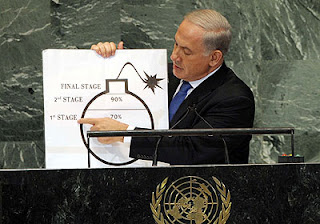
5. Forget the cartoon bomb that's generated so much buzz. The real last-minute prop in Netanyahu's speech was his notion of red lines for stopping Iran. It used to be that Iran had to be prevented from reaching "breakout capacity" -- the point at which it could continue to produce a weapon on its own. Then there was the "zone of immunity" -- the point at which Iran could continue its program without vulnerability to an aerial attack. Now the "red lines" connote the point at which Iran has enough highly enriched uranium to produce its first bomb ("90%") -- leaving a window as narrow as a few weeks (according to Netanyahu). Let's forgive the Obama administration for not updating its policy language fast enough to keep up with Netanyahu's moving goalposts and changing labels, but it now appears that all the hype was just that -- Netanyahu's red lines just happen to correspond neatly with longstanding U.S. policy. Or, as Netanyahu's people have phrased it, President Obama now agrees with the Prime Minister. Smooth...

6. One more shifting benchmark is the effectiveness of sanctions, which until last week were being downplayed by Netanyahu as largely ineffective. But after a phone chat with President Obama, and the leaking of his government's own report that international sanctions are actually having a great impact on Iran, his speech encouraged governments to continue pushing the very sanctions and diplomacy that his minions have been ridiculing.

7. The speech built up to a crescendo of apocalyptic doom and urgency, only to finish with no clear steps for implementing his red lines. After months of spiraling rhetoric and reports about the immediacy of the Iranian threat and the likelihood of an Israeli attack -- including widespread speculation as to whether such an attack would be delayed until after Madonna's summer concert -- Netanyahu pushed off any attack until the middle of next year, at the earliest. For those who honestly believe that next summer will already be too late to stop Iran, Netanyahu's speech was a blatant act of betrayal. The rest of us will have to scratch our heads and try to get back to serious business, which includes stopping Iran's nuclear program.

"It is a tale told by an idiot, full of sound and fury, signifying nothing." -- Shakespeare, Macbeth.

September 23, 2012

Hello, World? Meet Israel, the Victim State.

As world leaders gather in New York for the annual opening of the United Nations General Assembly, the Israeli Government and Jewish organizations have pulled off a great feat: a quasi-official UN event focused on the Jewish refugees from Arab countries, most of whom were expelled from their homes in the immediate aftermath of Israel's 1948 founding. This big diplomatic breakthrough follows on the UN's first-ever official Holocaust commemoration, back in 2005.

Surely, this was a coup for Israel in its diplomatic score-keeping against Iran, the Palestinians and the Arab states, but how does this help the Jewish State on a world stage, as embodied in the UN General Assembly opening?

Israel stands for so many achievements, cultures, aspirations and industry -- and what it chooses to show the world is martyrs and victims? The Holocaust remains unique in terms of its focus, scale, and ingenuity. Unfortunately, our world has since eclipsed the Holocaust's depravity and numbers of dead, but the Holocaust -- while not Israel's most forward-looking message -- rightly demanded inclusion in the UN's pantheon of historic events and founding lessons, appropriately devoid of political overtones.

This latest UN event has trivialized the Middle Eastern victims thanks to its explicit "me too" purpose of matching any Palestinian grievances with Jewish counter-suffering. Anyone following the daily massacres in Syria and elsewhere might be wondering why the suffering of onetime Jewish refugees should rival that of present-day Palestinians, Somalis, Libyans, or Sudanese (some of whom are now facing mob violence, detention and deportation...in Israel). What universal lesson can be applied from this experience: That Jews can also be victims (yet again)?

Israel ranks as a major world player in medicine and science, technology, democracy, humanitarian assistance and development, economics, and so many other fields. Its leaders are routinely consulted by their counterparts across Europe and Asia on a host of pressing issues... or at least they used to be.

It certainly stands as a tribute to the Middle Eastern Jews who endured suffering and dislocation so many years ago, and they have every right to seek maximum exposure and recognition. But Israelis and Jews at large need not have made this our opening pitch, underscoring our collective weakness and shared suffering (a classic anti-Semitic image, by the way) rather than our vision for a better world and a better region.

Like so many other enterprises these days, I get the sense that Israel's government arranged this latest promotion because it was able to do so, not because it was the best way to advance Israel's interests. Or maybe we've all just run out of ideas.

March 13, 2012

Remembering the Struma, at 30 and 70 years

Seventy years ago, on February 24, the Struma sank with some 800 starving passengers and crew, deliberately cast adrift and probably torpedoed by a Russian or German submarine. Adding to the tragedy were the circumstances: The Struma had sailed from Constanta, Romania, with Jews escaping the Holocaust; Turkey refused them entry at Istanbul unless the British guaranteed their visas to continue on to Palestine; the ship lingered for days, then weeks, and was eventually towed back out into the Black Sea. Horrible. Unnecessary.

Thirty years after the Struma sank, we spent a long summer in Bucharest, getting to know the brutality of Communism -- and the daily luxuries of the Diplomatic Club -- firsthand. We also spent some wonderful days along the Black Sea resorts, including Constanta -- not yet aware of the dark association with the Struma. The closest friends we made there were Millie and Otto, who were spared the concentration camps of World War II, though Otto had endured the Russian Front and together they faced the darkest of Ceausescu's Marxist fantasies. As a young woman, before the war, Millie had managed to spend a year in the States, so her English was excellent and her regrets consuming.

I gradually absorbed
Millie's story, over successive visits to Romania, as I grew old enough to comprehend. During the war, she was working for the telephone exchange and had saved enough money so that -- when one of her sisters booked passage aboard the Struma with her husband -- Millie was able to pay the fare for a younger sister to join them, presumably heading to safety. Later, as the ship sat in quarantine off of Istanbul, the husband's international firm was able to pull some strings and get landing cards for the married couple -- but not for Millie's second sister. All three stayed together aboard the Struma, and all three perished.

March 9, 2012

Auschwitz won't stop Iran

2009: Bibi proves the Holocaust was real...
I shouldn't have to say this, but: I take the Holocaust very seriously, and much of my schooling and my career has been devoted to studying and honoring the memory of the Holocaust.

Having said that, and setting aside my concerns with some of Israeli Prime Minister Netanyahu's strategic and diplomatic behavior vis-a-vis Iran, he seems dangerously obsessed with applying Holocaust terminology to contemporary situations.

Sometimes, as I blogged last year, he has used the Holocaust to try and impress world leaders with the overwhelming evidence that the Holocaust is a historical fact, and that therefore Iranian President Ahmadinejad is lying... and that therefore Iran has no right to develop nuclear weapons. Right. The problem is, there are a few logical gaps there, beyond the fact that the United Nations -- where he delivered such a speech -- had already established a firm policy of Holocaust commemoration and condemning Holocaust denial. And Netanyahu played no part in that achievement (as reflected in his speech).

Evidently, the Prime Minister was looking to impress his voters back home, and it worked -- as usual. This is becoming a ritual for him, much like Rudy Giuliani trotting out 9/11 at every opportunity back when he was running for President.

September 19, 2011

The Israeli UN speech that can't

At the United Nations, Israel seems destined to continue squandering its starring role on the global stage, only to play to the hometown audience. Last time around, it was Holocaust heartstrings, and this week it will be Palestinian politics. And beyond squandering, it's actually undermining Israel's diplomatic and political interests. 

HOLOCAUST

Two years ago, when Prime Minister Netanyahu last represented Israel at the annual opening of the United Nations General Assembly, he used his speech to defend the historical record of the Holocaust in the face of denials by the Iranian President Ahmadinejad. Ironically, Ahmadinejad omitted that very libel from his own UNGA remarks, so the only one that week to highlight doubts about the Holocaust was the Prime Minister of Israel. 

This whole exercise came four years AFTER the UN had finally begun recognizing and institutionalizing the scale, lessons and implications of the Holocaust, and the UNGA had already adopted a resolution condemning denial of the Holocaust -- with Iran implicitly the target. And in a perverse twist, just weeks earlier, Netanyahu's political allies in Israel and the United States had blasted President Obama for lecturing the Muslim world about the intimate connection between the Holocaust and the founding of the Jewish State, as though Obama were reducing Israel to just a Holocaust metaphor. Then the same critics turned around and praised Netanyahu for essentially doing the same thing.

To a world that had recently committed itself to the inadmissibility of Holocaust denial, Netanyahu validated the naysayers by literally waving documentary evidence in their faces. Israelis loved it, but it was neither relevant nor timely. 

PALESTINE

This week, Netanyahu returns in person, after letting his Foreign Minister address the UNGA last year on the merits of population transfer. What will the Prime Minister stress? The injustice of recognizing a new Palestinian state at this time.

Leaving aside whether it is unjust and/or unwise for the Palestinians, Israel is itself a sovereign country, with much more to offer the world than a stand against Palestinian self-determination. So is this really what the Prime Minister wants to put front and center as Israel's annual message to the assembled world leaders? Apparently so.

March 14, 2011

With policies like these, who needs terrorists?

"Aw, Johnny, 40 years old and she's still runnin' your life!" -- Moonstruck.


Too often, politicians claim they're leading when they're really just reacting, and they subordinate their priorities to outside influence rather than really taking charge and asserting national interest. Worst of all, most people seems to go along without noting what should be obvious. Over the past several days, this has been the case in the United States and in Israel.


HOW U.S. JUST HELPED THE TERRORISTS

In the United States, last week's first Congressional hearing on the presumed threat from the radicalization of American Muslims got underway. No hard evidence was presented that American Muslims are inherently a threat or that this discrete topic is useful for Members of the House of Representatives to devote their attention. However, it is only the latest in a long series of public actions since September 11, 2001, where we have allowed our enemies to determine our national agenda.

Al Qaeda has declared their goal of radicalizing American Muslims, so naturally some Members of Congress have now made a big fuss about the radicalization of American Muslims. If this has any real effect, it will be... the radicalization of American Muslims. We have handed a victory to Al Qaeda without the need for any further attacks on U.S. soil. Our real emphasis, and that of the House Homeland Security Committee, should be on preventing the actual terrorists, whoever they may be, based on the best available intelligence forensic analysis. And yet, the hearings are advertised as safeguarding America. Is Rep. Peter King really a better American than those who oppose his hearings?

HOW ISRAEL JUST REWARDED THE TERRORISTS

In Israel, the government has responded to the monstrous massacre of a young family in the West Bank by 
announcing hundreds of new housing units in the West Bank. Evidently, the timing is meant to show that the Netanyahu government will not allow Palestinian terrorism to force Israel into risking its national security. For the past few decades, however, very few settlements have served a security purpose, rather they have compelled a massive military presence to protect each additional residential neighborhood that gets built over the Green Line. If those settlements are a fundamental statement of Zionist fulfillment, then why package them as a response to Palestinian attacks on Israeli settlements?

March 3, 2011

Fear is no recipe for Jewish continuity

Hypothetical: A philanthropist commits $100 million for Jewish summer camps to promote Jewish identity. She commissions a consultant to propose a curriculum, and the result offers four pillars; the Holocaust, anti-Semitism, Iran, and Palestinian terrorism.
The good news is, for several generations already, Jewish summer camps have been infusing their immersive environment with with positive, and mostly intrinsic, Jewish energy. For those who haven't been there and done that, a new study reports that adults who attended Jewish camp as children are 45% more likely to attend synagogue at least once a month, 55% more likely to feel very emotionally attached to Israel, 30% more likely to donate to the local Jewish Federation, etc. 
If Jewish camps can pull this off each summer without resorting to guilt, fear and paranoia, our community as a whole should reconsider our year-round messaging to young Jews across the board. Do we really expect that Jews who did not have the advantage of Jewish camp or other holistic identity-building will want to affiliate Jewishly if we love-bomb them with a legacy of persecution and imminent threats to Jewish existence? 
Any Jews who are moved to affiliate in response to such negative appeals -- and we all receive the letters each autumn and December warning us of imminent Jewish destruction if we don't send cash ASAP -- end up skewing our communal consensus of priorities and challenges once they're inside the tent. Honestly, the same goes for people who accept God's existence after realizing that every 50th letter of the Torah spells out some convenient formula uncovered by algorithms. 
If we're serious about Jewish continuity, we need to take some lessons from what works in the long run, not just what pulls in a few quick bucks or boosts attendance at a singles mixer. And if we're serious about a Jewish future, we need to think more seriously about how to make all this continuity worth the effort. Forcing our communal leaders to spend a summer in Jewish camp might be a good way to start. 

November 1, 2010

Remarks at International Conference on "The Legacy of World War II and the Holocaust"(delivered Dec. 16, 2009)


When I first visited East Berlin in 1971, as a small child, it never occurred to me that I would live to see the Wall collapse and with it the Soviet Union. Even more remote was the concept that I might return here three decades later to participate in an international conference where 55 governments joined in a declaration to combat anti-Semitism, or that yesterday I would participate in a wreath-laying by Jewish leaders at the monument to Soviet liberators of World War II. And here, I stand before you, those same community leaders, including many of the survivors, liberators and heroes. Thank you for this honor.

History is surprising, and yet not so strange as it might seem. Jews were instrumental in winning the World War, and also in defeating the excesses of Soviet tyranny decades later. Jews are leading the way for a religious, cultural and social renaissance in Russia and other successor states, indeed, across Europe and in the United States and Israel.


October 31, 2010

Whose Holocaust Is It, Anyway? (originally posted Oct. 5, 2009)

Q: Who owns the "Holocaust" brand? Who owns the right (or better, legitimacy) to apply the term "Holocaust" to any policy, social or religious issue?


A: No one

I call a moratorium. Nearly 65 years after the end of World War II, it is time to remove the "H" word from our political lexicons and leave it to the realm of history and thought. Ahh...whatever happened to thought?

Extremists on the right and left alternately use the term to characterize everything from abortion to lack of health insurance within the United States, to Israeli policies against the Palestinians, to anything that anyone wants to portray negatively.