Showing posts with label Iran. Show all posts

November 21, 2018

History forgotten, Saudi Arabia trumps Pakistan and Iran

President Trump uses American jobs as the reason he’s setting aside the CIA’s report that—as has been inescapably obvious for weeks—Saudi Crown Prince Mohammed bin Salman ordered the brutal murder of dissident journalist Jamal Khashoggi in their Istanbul Consulate. How about the thousands of American jobs already being lost as a result of the President’s new trade war with China—the one he said would be “easy”?

Another reason the President gives is Saudi Arabia’s support for his take-no-prisoners policies against Iran, despite the Islamic Republic’s continued compliance with the multilateral nuclear agreement. Coddling a brutal autocrat—the Shah—was how we lost Iran 40 years ago in the first place. What happens when the Saudi regime is overthrown because we encouraged their excesses? And who will take over then? Meanwhile, the homegrown Saudi animosity against Iran requires no incentivizing from Washington.

In almost the same breath, on Twitter, the President also slammed Pakistan for allowing Osama bin Laden to hide from justice. And what does Pakistan do for us anyway... Well, aside from the fact that our assistance helps stabilize a regime that owns nuclear weapons, and that—with a few well-placed Trump tweets—Pakistan could be far more anti-American than it is—let's stop and really think for a moment about OBL.

Let’s consider not where Osama was hiding, but where he got his start and his cash and nearly all the recruits for his 9/11 attack on our homeland. That’s right—Saudi Arabia!

So, if enabling Osama is the litmus test for cutting off relations, then why is Donald Trump doubling down on the Saudis?

April 5, 2017

What Trump could do NOW on Syria

Following this week's massacre of civilians by Syrian government forces, using specialized chemical weapons, a friend asked me what President Trump should do at this stage. To recall, President Obama averted military intervention by securing Syrian President Assad's agreement to remove all chemical weapons. While Obama should never have thrown down a red line over Syria's potential use of chemical weapons, it could have been catastrophic for the region and the United States had he backed that up when Assad indeed deployed such weapons. 

To be sure, with Russia and Iran's active support Assad has been committing mass murder and devastation against his own citizens. But until last week's indication by Trump's Secretary of State that the UnitedStates is ready for Assad to remain in office, Assad had avoided using more than off-brand chemicals such as dropping barrels of chlorine.

A friend has challenged me to suggest what Trump should do at this point, beyond empty statements. 

So here are a few ideas:

1. A statement condemning would be a good start. 

2. Countermanding Tillerson's explicit approval of Assad's legitimacy would be even better. 

3. Demand that the Russians cooperate in holding Assad accountable and removing these new stockpiles (which Russia may have itself supplied. 

4. Get ahead of the courts and formally rescind the U.S. ban on refugees from Syria who have already been exhaustively vetted -- and call on European nations to redouble their own programs.

Obama came in on the heels of George W. Bush's obliteration of Saddam's orderly dictatorship, which unleashed the cynical and destructive forces of the self-proclaimed Islamic State. That same obliteration freed Iran to pursue its goals in Syria largely unchecked. Obama made some missteps, but he did better than average with what he'd been dealt -- and at least he tried. 

Trump may still have a narrow opportunity to minimize the damage from the current situation, but by accepting Russia's dominance and legitimizing Assad, he's already taken a bad situation and made it so much worse.

August 21, 2015

Appreciating Jimmy Carter

Jimmy Carter redeemed our nation after the carnage of Vietnam and Watergate. At Camp David, by sheer force of personality, he saved Israel from having to continuously mobilize on two fronts, which probably set the stage for Startup Nation. 

He boycotted the 1980 Moscow Olympics over the invasion of Afghanistan. He signed off on a daring mission to free the U.S. Embassy hostages in Tehran, and he paid the price. He has some issues with Israel, which is his right, and that pains us because he still has sweeping moral authority in an era when it's become a scarce commodity. 

Every year he sticks around, he saves a few million more people with housing, public health and poverty-relief initiatives. We have been blessed by his service and example, and his legacy is secure. Thank you, President Carter, and God bless.

February 4, 2015

Instead of denying he's naked on Iran, Bibi should put on some clothes

As much as I've tried to avoid it, the Netanyahu speech flap keeps festering and snowballing at the same time. In the mass media. 

Everyone involved is a calculating politician, so let's not pretend otherwise. Let's not pretend the White House was entirely above-board, and let's not pretend that the speech and its timing aren't more about Republican and Likud politics than about Iran's nuclear program. The idea that the looming deadline for nuclear negotiations and Israel's upcoming elections just happen to coincide, ignores the fact that Netanyahu decides when to call elections. Even FoxNews has criticized the idea. 

It's no longer about putting some pressure on the negotiations, so they fail. By being so obvious and over-the-top, Netanyahu has rebalanced the scales in Iran's favor, making it incrementally harder for the Western powers to exact the same concessions from Iran.

Democrats who rank high on AIPAC's friends' list are considering whether to skip Netanyahu's speech altogether. In all the decades of U.S.-Israel partnership and tensions, that's a first, it wasn't inevitable, and it hurts Israel more than it hurts Obama, Boehner, or even -- and especially -- Iran. As for Netanyahu's hometown audience back in Israel, we'll have to see whether he gains more votes than he loses, especially with right-wing contenders like Foreign Minister Avigdor Lieberman trying to outdo him on the Paris attacks and Jordan's fight against ISIS.

At this late stage, IMHO, the best thing for everyone, including Netanyahu and the nation he leads -- and for the case against Iran -- would be for the PM to step back, apologize for falling into petty politics, and wait until after elections to schedule an official visit. Given that even Netanyahu's confidant and Washington envoy has already passed the buck, I have no illusions this will happen. But then Israel's national anthem is entitled "The Hope"...

November 24, 2013

Netanyahu's new rogue state is Israel

Hours after the five Permanent Members of the United Nations Security Council (the "P-5") announced an interim deal that pulls Iran back from the threshold of nuclear weapons capacity, Israeli Prime Minister Benjamin Netanyahu has done more than denounce the agreement. By reasserting Israel's right to attack Iran at its own discretion, even following this international accord, Netanyahu has effectively set Israel as the Middle East's new rogue state - even without actually attacking Iran.

With Iran formally committed to the agreement, Israel is now the nation standing defiantly against world opinion and the international community. None of those countries party to the agreement - including France and the United States - can now abide an Israeli attack. 

Israel is routinely criticized and condemned, with or without justification, for all manner of violations of international law. Yet it enjoys positive relations with dozens of countries and is seamlessly integrated into the global economy, and it has never directly defied the Security Council. Though the Council as an entity has not formalized the agreement, the P-5 and the European Union are all officially signed on. Agree or disagree (as I did elsewhere) with Netanyahu's assessment of the negotiations and the deal, he is now declaring Israel to be above the Security Council.

November 8, 2013

Netanyahu's fantasy date with destiny

Prime Minister Benjamin Netanyahu has consistently acted as though Israel has a veto on any negotiations with Iran, as though reminding world powers - and Tehran - that Iran's nuclear program is only a concern for Israel and not for the entire region and the international community. Every step forward in the process has been derided, every sanction discounted, even as he says it's better than nothing. Even as he acts like the judge for all nations.

Netanyahu speaks as though only he and only Israel are concerned or actively fighting Iran's ambitions. He has already ridiculed the discussions underway in Geneva as "The Deal of the Century," even though limiting - and not completely dismantling - Iran's nuclear program was always the stated goal. He warns us all not to trust Iran, as though anyone outside Tehran trusts that regime. Anyone. This isn't about world leaders being naive, it's about working within political and strategic realities.

What Netanyahu won't acknowledge, is that neither Israel nor America has a way to decisively stop Iran's quest for nuclear weapons. The best option is some deal for verifiable controls on further enrichment and weaponization. While dismissing the use of sanctions or negotiations, the Prime Minister has offered no realistic alternative. None. 

Despite his tough talk, there is no surefire way to deny Iran a nuclear capability. Sanctions, blockade and assassinations have pushed Iran to the point of considering measures to verify and limit its program going forward. There has never been a point at which any U.S. President or Israeli Prime Minister could have permanently neutralized Iran's program, either successfully and effectively or without Israelis paying a catastrophic political and economic cost. Israel's own military experts have routinely warned against attacking Iran.

October 30, 2013

Can Jewish leaders take 'yes' for an answer?

It's happening again... The Obama administration is inviting American Jewish leaders into the White House for substantive, high-level consultations on matters integral to U.S. and Israeli national interest, and (some of) these American Jewish leaders are publicly trash-talking the Administration within the same news cycle. 

During President Obama's first term, this happened a few times, when organizational leaders leveled complaints and demands to the President's face and to reporters. Last year, Jewish leaders were so critical of the President's nomination of Chuck Hagel as Secretary of Defense, they gave journalists 'anonymous' negative quotes during the President's own Hanukkah party -- and trust me, that's no easy invite to snag.

This week, the President's National Security and other senior advisers met with Jewish leaders to discuss the Administration's approach to nuclear negotiations with Iran. Even as the White House guests described the meeting as "constructive", one of those same leaders was blasting Secretary of State John Kerry for publicly refusing to "succumb to fear tactics" by critics of the U.S.-Iran talks.

If the Secretary of State states something on Monday, and you're meeting the National Security Adviser on Tuesday, why not use that meeting to raise your concerns? Especially if your bone with the Secretary is that -- if he had any implied criticisms of Israeli Prime Minister Netanyahu (the perennial Cassandra on Iran) -- he "should have made them privately." 

Substantively, there seems to be no alternative to talks with Iran, since a military solution is at best costly, and unlikely to achieve a decisive outcome. It's Obama, and not Bush or Netanyahu, who succeeded in instituting "crippling" multilateral sanctions against Iran, all for the purpose of securing a realistic halt to Iran's weapons-oriented nuclear projects. If Netanyahu and Obama (and Kerry) have a difference of opinion, do they really need an American Jewish arbitrator?

In this case, the particular Jewish leader's concern was that friends don't need to air their disagreements in public. By this measure, various Jewish leaders don't appear to be "friends" of the President or his administration, or his Secretary of State. But as loyal Americans and Israel advocates, they might consider which is the best path to securing our shared future, one based on trust and humility, not grandstanding and paranoia.

February 19, 2013

Are we willing to see Bahrain step up?

It certainly has been painful and confusing to watch Bahrain again deal unevenly with internal political tensions under the spotlight of powerful and polarizing neighbors like Saudi Arabia and Iran. Now, it seems, Western opinion-shapers aren't much interested beyond the spectacle of clashes between demonstrators and government forces, and the mistreatment of opposition figures.

For all the media and political attention of two years ago, and even the most recent violence coming on the second anniversary, there has been scant coverage of the National Dialogue now underway. Of course, it would have been easier to advance this grievance-airing and consensus-building BEFORE the anniversary of the tragic crackdown, but there's still little excuse for ignoring it. 

It's always possible that wise diplomats and responsible journalists want to give space for the dialogue to proceed without the distraction of global visibility. But just weeks ago, Bahrain's Crown Prince raised the curtain for the National Dialogue before an audience of regional and international leaders, reporters, policy mavens, and even yours truly. This is no secret conversation, and reform-minded Bahrainis like Prince Salman seem to think publicity will help incentivize all Bahrainis -- including the ruling classes -- to give a chance to reconciliation and even to limited democracy. 

I assessed Washington's cautious role for Josh Rogin during last December's Manama Dialogue, "Since the last time we had this summit two years ago, Bahrain has been going through a difficult period. Bahrain has been assailed on Capitol Hill and elsewhere and perhaps rightly. But what has the U.S. government done to help Bahrain get through it? We've left it to other countries, we've left it to international organizations and NGOs. Maybe that's worked, but we can't take credit for that."

Why not help the Dialogue conveners help Bahrain, or at least put them on the spot? Perhaps the international community is wary of rewarding Bahrain with positive press before it's been redeemed by those inside and outside who oppose its ruling family. While our new Secretary of State is in the Gulf next week, he might take the opportunity to bolster those striving for a solution, even at the expense of angering fundamentalists in the region and absolutists back at home.

January 9, 2013

On Hagel, Jewish groups squandered an opportunity

Despite all the public kvetching about Israel and "the Jewish lobby" (by our own Jewish lobby), serious policymakers in Washington and around the world are far more interested in what Chuck Hagel's nomination for U.S. Secretary of Defense means for Iran than for Israel. Had American Jewish organizations figured this out, and/or had they cared, they would have joined the conversation about substantive next steps to end Iran's quest for nuclear weapons, which is about expert problem-solving rather than ideological litmus tests.

But no. Major and minor groups -- "mainstream" and outright Republican alike -- are tweeting and blogging their "pro-Israel" talking points, and Senators are being inundated by the same kinds of knee-jerk admonitions that used to make recovering Senators like Chuck Hagel and Joe Biden roll their eyes back on Capitol Hill. Despite this, a third former Senator, Barack Obama, has pushed forward to counter Iran and address its nuclear program in ways his predecessor could not. And still, our community seems incapable of acting like Obama's partner instead of his conscience.

When the Senate Armed Services Committee considers Hagel's nomination, I do NOT want to hear his views on why Israel is our most reliable ally in the Middle East, or anywhere. At the dawn of a new Congress and a second Obama term, this should be the opportunity to address major decision points on Iran (sanctions, force projection, counter-terrorism), Afghanistan, North Korea, and the fundamental budgeting and direction of our military infrastructure, preparedness, and personnel.

Israel's security will not be enhanced by becoming the centerpiece of confirmation hearings for a Cabinet post which by definition involves close cooperation with Israel's military establishment. Any distraction from the  strategic UNKNOWNS in the region and globally will undermine the stated goals of the Jewish advocacy organizations that are mobilized at this moment, whether to oppose Hagel outright or merely under the pretense of asking "the probing questions".

After Patriot missiles and Iron Dome, supporting Israel and U.S.-Israel relations ought not to be open for debate, yet major community organizations are inviting just such a re-examination through their expressions of "concern". Who cares whether Hagel would have been the "first choice" of any American Jewish leader? SHOULD we care, and if so, then why exactly?

Like most of the big decisions facing America at this time, this one should not be about Israel or Jewish organizations. Trying to make it that way diminishes our relevance as a community, for ourselves and to the world. Most importantly, it diverts attention from Israel's true needs and those of the United States.

December 13, 2012

Iran's sense of vulnerability casts a wide net

The Gulf expects more from the United States, and less from Iran. Surprised?

On the military side, admirals and generals want to know our plans and protocols for managing the threat from Iran, on tactical as well as strategic levels. Politically, diplomats and bloggers alike blame us for letting Mubarak fall in favor of the new Islamist Pharaoh, Mohamed Morsi. On Syria, opinion is divided on whether the United States ought to directly intervene militarily or simply provide advanced weapons to the rebels. But then maybe, judging from the current blowback on Morsi and his ascendant Muslim Brotherhood, we should be stepping in to prop up Syrian President Bashar Assad... Stability vs. democracy, or secular vs. religious autocracy.

Reflecting the outdated relevance of Wikileaks, Gulf regimes are no longer itching for a U.S.-Israeli attack on Iran's nuclear facilities. Instead, they are acutely aware that if Iran gets lucky with just one anti-ship mine, all oil shipments will come to a standstill. The closer Iran gets to achieving "breakout" capacity, or to crossing one of Israeli Prime Minister Benjamin Netanyahu's ever-shifting "red lines", the more regional leaders understand that neither diplomatic nor military options promise an easy resolution. And once again, regardless of the nuclear file, Iran's ongoing opportunism is evident in Egypt, Syria, Lebanon, Gaza, Iraq, and potentially Bahrain. The regime in Tehran is as happy to take advantage of popular Arab unrest as it was to seize full control of Abu Musa from the United Arab Emirates 20 years ago (or to regain its former sovereignty, according to the Iranians).

For all their defiance and bluster, Iranians remain concerned about their own rights to security and national self-defense: The entire punitive premise of international nuclear negotiators and the sanctions backing them up leaves Iranians feeling humiliated and cornered. This is not merely posturing -- it's a genuine feeling.

I do not discount Iran's violation of international treaties and conventions on the transparency and verifiability of its nuclear program, nor its propensity to support terrorism and undermine diplomatic solutions, especially where the Israelis and Palestinians are concerned. Sure, Iran is responsible for its current dilemma. But so long as Iran feels deep down that its very sovereignty and survival are being threatened, it is unlikely to willingly give up what has become its nuclear insurance policy.

While the West cannot afford to back down, it is increasingly likely that Iran will nevertheless succeed in attaining nuclear weapons capacity within the next five years. Leveraging the existing and future sanctions and other measures, it may be possible to fashion a process and terms of reference that acknowledge and allay Iranian fears and also establish a framework for taking the centrifuges off line.

An Iran that WANTS to own nuclear weapons can potentially be deterred. An Iran that feels it NEEDS to own nuclear weapons will be truly dangerous and unpredictable. If our efforts to prevent a nuclear-armed Iran are able to address both points, we just might succeed in the short term and also open the door to a long-term process of normalization.

December 8, 2012

"Ilaynaa?" This is us you're talking to...

This year's Manama Dialogue, back after skipping last year amid Bahrain's internal strife, has produced some notable public statements and many private conversations. There's a tremendous degree of up-to-the-tweet knowledge and keen interest about what's going on in Washington, not to mention around the Middle East. The U.S. and other delegations have been delivering alternate doses of reality and humility to the mostly Arab participants -- government and military officials, as well as media and policy experts. [I am here again as a grateful guest of Bahrain's Foreign Ministry.]


So far, the most audacious statements have come from Qatar's foreign minister, who suggested to the audience that Syria's rebel forces could use MANPADS (shoulder-launched surface-to-air missiles) to secure a no-fly zone. He dismissed concerns that such weapons finding their way out of the country and into the hands of terrorists, as happened in Libya: Syria is different, because its neighbors are all secure and stable!! Who knew...

The cheekiest question from the floor was addressed to the U.S. delegation by a drôle Brit (who else?): "How long are the American people prepared to continue to bankroll the security of Chinese oil supplies?" Ouch.

Senator John McCain delivered a strong case for greater U.S. leadership and involvement in the region, including military intervention in Syria and more engagement and democracy-building on the ground in Libya. As a reflection of Washington's complicated politics, the Senator has recently devoted much of his time to assailing the Obama administration for the attack that killed four Americans in Libya, who were there precisely as part of the President's commitment to engage Libyans and help them build a democratic society.

Generally, there was little emphasis on the Israeli-Palestinian issue this time, whereas two years ago Jordan's King Abdullah made that the focus of his speech here. The curtain-raiser was a panel on Syria, which included a leader of the Syrian opposition, and only at the very end, China's Middle East envoy threw in -- non sequitur -- that the Palestinian issue remains the biggest problem in the Middle East. No doubt, our Syrian friend got home safely by now...

Beyond Syria, Egypt remains a major item on the Manama agenda. It looks like some of the Egyptian delegation failed to make the trip after all, including the General who heads "Crisis Management" for the Egyptian Armed Forces. The second day's sessions concluded before the news of Egyptian President Morsi's scaling back much of his decree for unchecked power, which may mean the restrained U.S. response to that crisis actually worked -- let's see what the buzz is on Sunday...

There is ambient frustration with the U.S. Government over the sense that Washington has withdrawn from the Middle East, including from the Israeli-Palestinian issue, exhausted as we are from waging two major wars in this region and now peering over The Fiscal Cliff. 

While conspicuously omitting America from the list of nations that were helpful to Bahrain through its recent turmoil, Crown Prince Salman's keynote did give a little pitch (or dig) for us to get "the state of Israel" back into negotiations. In other words, while according Israel all due legitimacy, His Royal Highness asks if Washington can maybe do one little bit of heavy lifting once and for all. With flag officers in the room, of course, it's also hard to forget that Bahrain is home to the U.S. Fifth Fleet, which patrols the waters of the Gulf and Straits of Hormuz among other strategically vital sectors. Let's just say, both parties benefit from the arrangement. And as it happened, Senator McCain was late arriving from Kuwait, so he was not in the room for this royal treatment.

More significantly, the Crown Prince emphasized and acknowledged the trauma his country has endured since our 2010 session, with many mistakes by the authorities that need to be addressed and corrected going forward. In this, his speech was not so much PROMISING a "new Middle East" as DELIVERING it in substance. Time will tell as to implementation and fulfillment, but it was no ordinary speech. And he predicted more substantive announcements in the coming days.

Picking up on the Crown Prince's appeal, British Foreign Secretary William Hague also called on the United States to re-engage Israel and the Palestinians before time really runs out. He framed his entire speech within a spirit of humility, noting he is "not a citizen of the Middle East" and therefore not prepared to lecture Middle Easterners about their own region. Obviously, his most immediate concern was the situation in Syria, and there was much deliberation throughout the sessions about the efficacy of internal resistance and outside diplomacy, and heated calls for military intervention, with or without waiting for the Assad regime to deploy chemical weapons (and with or without Russia's imprimatur). Military and security experts were also confident they can secure Syria's weapons stockpiles once Assad is gone. If...

Hague and the Americans -- and the Saudis -- paid special attention to Iran's role in the region, as well as its nuclear program. As we take on the progress and challenges of a "new" Middle East, it's also sobering that the region's two biggest flash points are Egypt and Syria. A half-century ago, these two key Arab nations were briefly united into one country by Gamal Abdel Nasser, who heralded a new kind of pan-Arab Middle East. Nasser's promise largely failed, and today we face new and distinct changes, risks and potential in both countries, with consequences for the entire Middle East and beyond.

December 7, 2012

Arab Spring overplayed & underestimated

This week, as I made my way to the region, I've been following the dramatic downturn of democratic governance in Egypt. A few initial thoughts before I hear more informed  perspectives:

PEOPLE POWER

While President Morsi's Mubarak-esque combination of autocratic proclivities and astounding detachment from reality are deeply alarming, the Egyptian people are again rising up in protest. So, the biggest beneficiary and hallmark of the "Arab Spring" is proving to be More Of the Same, but the democratic spirit of the movement -- the citizens themselves -- is unabated. They still expect functional, legitimate democracy, whether from Morsi's Muslim Brotherhood or someone else. And anyway, few reputable analysts were banking on Morsi's prospects as a democratic visionary. But elections do have consequences, especially when they're held too early.

THERE IS ANOTHER

We need to excise Morsi as the face of the Arab Spring, lest his blowout come to symbolize the whole Arab Spring. If Egypt's experiment fails, this by itself does not prove the Arab Spring was a ruse or a mirage -- as some of my fellow American observers have been blogging in recent days. Owing to its size, intellectual history and strategic importance, Egypt easily took first place as the symbol of the Arab Spring. Egypt may still prove to be the big test of this sweeping movement, yet other countries are also processing their own versions. 

Tunisia, where the democratic tide started last year, is showing the kind of measured progress that Western news anchors take for granted, and thus makes for few headlines. Despite continued uncertainty, including the recent Benghazi attack that killed four Americans including the U.S. Ambassador, Libyans remain optimistic and supportive of their new democratic-trending government. 

In Bahrain, last year's protests and the ensuing crackdown were largely limited in time and scope. The grievances remain and will need to be addressed one way or another, but this is not the garden-variety Arab Spring, especially since Bahrain is sandwiched between Iran and Saudi Arabia -- two of the least democratic regimes in the region. 

Syria's Assad regime is holding fast, for now, amid popular unrest and armed rebellion. Much will depend on Bashar Assad's individual mindset: He could hold out until the end, leave town just after his kids open their Christmas presents, or start using chemical weapons against his own citizens. That third option could provide a casus belli for U.S.-NATO intervention, which will horribly escalate the violence but may also end the dictatorship and keep Iran out of the post-Assad politics.

THE KINGMAKERS

The role of non-Arab states within the Middle East will also help determine the direction of political change in the region. Iran's support for Assad and its opportunistic use of Morsi's election in Egypt have been a negative influence on the Arab Spring, and should inspire greater resolve by reformers rather than a Western retreat. Turkey, once the moderate Muslim referee, needs to regain its composure and recapture its influence with Egypt and Syria in particular. Its recent military counter-attacks on Syria, its second fiddle at Morsi's Gaza cease-fire negotiations and the angry posturing against Israel are keeping the Islamist government from realizing its potential as mediator and guarantor among its neighbors.

The Arab Spring is definitely incomplete, even dangerous in spots. But this is the Middle East, after all. And the story remains unfinished and -- in too many cases -- untold. Instead of dismissing the significance or permanence of the democratic moment, Westerners should be joining with Arabs and others to see where and why the Arab Spring is faltering, and what we can do together to facilitate real, measurable and even lasting results.

November 29, 2012

Condemning Palestinian statehood won't help Israel

The United Nations General Assembly will vote today to accord Palestine upgraded Observer status as a non-member state. Had the U.S. Congress been more supportive of the Oslo process following the assassination of Yitzhak Rabin, had the international community exerted more pressure on Yasser Arafat, had Shimon Peres called earlier elections to capture the Rabin sympathy vote, had President George W. Bush not insisted on early elections in Gaza that put Hamas legally in charge there, this might have happened ten years ago, and with full membership for Palestine. But that's not what happened.

So today, on the anniversary of the UN's 1947 Palestine Partition plan, Palestinian leader Mahmoud Abbas is calling on the UN to recognize Palestine as a state. Some of the normal prerequisites for statehood status remain unfulfilled: There are no permanent, recognized, demarcated borders; the territory is ruled by two different governments; and the terms of the Oslo Accords mandate the Palestinian and Israeli sides to cooperate and agree on final status, including statehood.

But realistically, Oslo has been dead for several years, and certainly since President Bush backed off serious efforts to facilitate progress between the two parties. Realizing this, Ehud Olmert, Israel's Prime Minister at the time, continued his own regular meetings with Abbas and even followed through on Ariel Sharon's planned unilateral withdrawal from Gaza. And today, Olmert himself is backing the Palestinian bid. For his part, Israeli Prime Minister Benjamin Netanyahu has done little to back up his public calls for Abbas to return to the negotiating table, while expanding Jewish settlements across the West Bank and empowering Hamas while generally ignoring Abbas.

Especially following the recent conflict between Israel and Hamas, and the Egyptian-brokered ceasefire, Abbas needs to proceed with today's vote. He needs to show something to remain relevant, and Israelis who retain any hope for eventual peace should realize that they need Abbas to succeed over Hamas, in the West Bank as well as Gaza.

While today's vote is not a vote against the existence of Israel, it definitely has an element of rejecting Israeli settlement expansion and U.S. neglect of proactive diplomacy. There are no guarantees, and today's vote may be ill-timed. And it will be used by Iran and others to cynically advance their campaign to isolate Israel diplomatically and otherwise. But the Palestinians will get their way today, albeit without the support of Israel or the United States. Given this reality, where do we go from here?

Israel and the United States have already decided to downplay the statehood status. This is more constructive than just cursing the darkness, but far from lighting a match. A year ago, the last time Palestinian statehood was being advanced at the UN, I blogged on how much easier it would be for Netanyahu to just work on peace negotiations with Abbas, both substantively and tactically as a way to undermine or forestall any statehood effort.

Even Netanyahu, and his coalition partners who more openly reject any territorial compromise, can reap some advantage from today's fait accompli. They can begin treating Abbas as the leader of a state -- not with ticker-tape parades through Tel Aviv, but by signing more formal agreements from economic relations to security cooperation and holding him more accountable for results. They can play up his role as the internationally recognized leader rather than giving Hamas more opportunities to escalate tensions and overshadow Abbas.

We can also use this as an opportunity to get more economic development and investment into the West Bank, by calling on European governments voting "yes" on statehood to put their money where their mouths are. Any effort to penalize Abbas for pushing the statehood issue will further erode his credibility and that of the peaceful path (Hamas has shown that terrorism gets better play with Israel). Israel needs a strong, vibrant, secure and prosperous Palestinian neighbor, and this is according to Prime Minister Netanyahu himself.

Jewish organizations should feel free to condemn and criticize today's vote, but afterward they should also be held to account. If we as a community reject unilateral measures, and we claim that today's vote undermines the path of direct negotiations and a two-state solution, what will we be doing in 2013 to achieve that oft-stated goal? Are we willing to back up our own rhetoric with candid advice to Israeli leaders, with our own funds to support Israeli-Palestinian cooperative enterprises, and to promote genuine dialogue and engagement between Jews and Palestinians?

As Jews prepare to celebrate Chanukah, the Festival of Lights, we should consider whether we will continue to curse the darkness, just keep quiet, or start lighting flames to brighten the room we call the Middle East. If we as a community are not up to that task, then silence may be the best answer going forward. Merely paying lip service to a "two-state solution" can no longer help Israel or the Palestinians, and it won't stop Iran from achieving nuclear-blackmail capability.

November 19, 2012

Gaza's gifts

It is intolerable for Israel's major population centers to be under attack. Ideally, Israel wants a cease-fire with Hamas, with international guarantees, or at least some outside verification, which will further elevate Israel's claims for the next time around. Israel's military offensive to neutralize the rockets and missiles being launched from Gaza against Israeli civilians also has broader and less direct implications.

ANTIDOTE TO ABBAS

As well, this is not the first time a right-wing Israeli government elevates Hamas at the expense of the more moderate PLO, now embodied in the Palestinian Authority as headed by Mahmoud Abbas. During the 1980s, Israel did not mind the ascendance of Hamas as a way of hampering the PLO's operational and political strength.

In addition to making Israelis more secure -- at least in the short term -- Israeli Prime Minister Benjamin Netanyahu reaps further political advantage by diminishing Abbas and reducing the Palestinian leader's capacity to sustain a moderate course that might eventually compel Israel to finalize territorial compromises leading to a viable Palestinian state. Such an agreement and such a state used to be an Israeli goal, but under Netanyahu these are reduced to mere rhetorical flourishes. Beyond further cutting down Abbas, the Gaza operation also distracts attention from any potential peace initiative heading into the second Obama term. These may not have been considerations in his decision to counter-attack now, but they must definitely be seen as fringe benefits.


November 8, 2012

The wannabe Jewish vote, à la Bibi

There continues to be an astounding fascination with the Jewish vote, mostly within the Jewish community. But it was never all about us, and this year that's especially so. Israeli Prime Minister Benjamin Netanyahu has reduced himself politically to a mere appendage of Jewish Republicans and big-money campaign donors. Even Israelis are noticing now. As for the rest of us, perhaps we can start getting back to reality-based politics, here and in the Middle East, and not be quite so proud of our community's king-making powers.

HOW JEWS VOTE

Jewish Republican activists may console themselves in the delusion that the Jews voting for Obama aren't REAL Jews, since Israel ranks only fourth or lower in deciding their votes. But then, most of the 30 percent who voted for Romney were voting because they are REPUBLICANS. Even in 1992, the sharply antagonistic President George Bush still managed to scare up 11 percent of the Jewish vote in his defense against the Democrat Bill Clinton.

The Jewish vote is clearly not in play, despite a marginal drop in its overwhelming Democratic bias. The vocal bulk of community advocacy organizations claiming -- however tenuously -- to speak on behalf of American Jewry had previously indicated their genuine or contrived concern with various policies and actions of the Obama administration, often inspired by statements or murmurings emanating from Prime Minister Netanyahu.


October 11, 2012

Israel's elections lead to fewer choices

No one can be surprised that Israeli Prime Minister Netanyahu has called for elections early in 2013, months ahead of the legal deadline. It's less common that Israel's faction-based political arena is static enough for everything to happen on time.

One key difference between Netanyahu and U.S. President Barack Obama relates to our different political systems: Each morning Netanyahu awakes in the PM's residence, his number-one goal for that day is to go to bed at the end... in the PM's residence. For Obama, on the other hand, regardless of how many circles a mid-level ally runs around him, each day he knows he'll be returning to sleep in the White House. This allows him to think a bit more expansively about the opportunities and challenges facing America and the world.

For Netanyahu, as for most of his predecessors, his primary calculation has centered on maintaining and increasing his personal political power and influence. Years ago, he was the leading advocate for direct election of the Prime Minister, figuring it gave him the best chance to get in over the heads of seniority-based faction leaders within the Likud Party. And he was right -- though the flawed process, which retained a Knesset's component, evoked Churchill's maxim about trying to cross the abyss in two steps.

Netanyahu has had to share the spoils of his office with people he dislikes -- politicians like Foreign Minister Avigdor Lieberman on the right and Defense Minister Ehud Barak on the left. Barak has stayed on despite abandoning his own party affiliation, largely as a useful check against Netanyahu's many rivals within Likud and Israel's broader, growing right wing. Truly, his is a government of enemies.

Having pumped up the twin threats of Iran and Obama as much as possible -- against a backdrop of Arab Spring, summer, and fall -- Netanyahu is well-positioned to pick up extra seats and toss out a few of his hangers-on. Domestic issues like perennial religious and budget priorities are also in play. And so is former-PM Ehud Olmert, not quite exonerated but mostly cleared to return to politics.

The only aspect that might have been surprising -- Netanyahu's contention that the dangers facing Israel demand a clear decision by the Israeli electorate -- is also no surprise, given the way he has inflated the specter of Iran (and, yes, of Obama) to the brink of irrelevance. This was demonstrated by his recent "eh, never mind" United Nations speech, which pushed off any urgency on Iran's nuclear program until next spring at the earliest and also fell in line with President Barack Obama's consistent strategy and perspective.

Regarding the Palestinian issue, Netanyahu has obvious ideological reservations about making any substantive concessions. As a side benefit, the longer Israeli-Palestinian tensions fester and flare, the less invested Israeli voters feel in any effort for a long-term solution -- and the more they rally around a bunker-mentality leader like Netanyahu.

Having lived in the States for a number of years, Netanyahu is well aware of our own forthcoming elections. And one televised debate notwithstanding, he's a bit worried that Americans will re-elect the current President. So Netanyahu needs to appear both conciliatory toward Obama and secure back at home. Being re-elected as Prime Minister -- and without Lieberman or Barak pulling him down and cutting their own side deals -- will be the perfect formula.

September 30, 2012

Netanyahu's 'hurry up and wait' moment

I have a few observations on Israeli Prime Minister Netanyahu's speech last week to the United Nations General Assembly:

1. Had the Prime Minister delivered the exact same speech to the annual banquet of any major Jewish organization or to the Israeli Knesset... well, maybe he already has. In fact, as usual, the target audience for his UN speech seems to have been Israelis and Jews around the world. The world leaders and diplomats sitting in the GA Hall were really just props, or better, foils so he could be seen "talking truth to power". Brilliant, if no longer original.

2. Netanyahu implicitly ceded the peace process discussion to the Palestinians, whose leader Mahmoud Abbas understandably focused his GA remarks on the Israeli-Palestinian issue. His only reference or rebuttal to the Palestinians was a brief nod to the concept of a negotiated solution and uniting the three great faiths.

3. By eclipsing the peace process with his usual lecture on medieval barbarians and clash of civilizations, and -- lest we forget -- the Holocaust -- Netanyahu allowed no hint that Israel is interested in substantively addressing the Palestinian issue. The message to European governments, and to the Russians and Chinese, is that their interest in regional stability can only be satisfied by helping Israel stop Iran. And Israel makes no promises after that.

4. Netanyahu's speech underscored the sense of many around the world -- including decision-makers whose support Israel and the United States still need -- that a nuclear Iran is an Israeli issue more than a global concern.

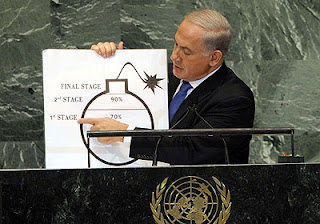
5. Forget the cartoon bomb that's generated so much buzz. The real last-minute prop in Netanyahu's speech was his notion of red lines for stopping Iran. It used to be that Iran had to be prevented from reaching "breakout capacity" -- the point at which it could continue to produce a weapon on its own. Then there was the "zone of immunity" -- the point at which Iran could continue its program without vulnerability to an aerial attack. Now the "red lines" connote the point at which Iran has enough highly enriched uranium to produce its first bomb ("90%") -- leaving a window as narrow as a few weeks (according to Netanyahu). Let's forgive the Obama administration for not updating its policy language fast enough to keep up with Netanyahu's moving goalposts and changing labels, but it now appears that all the hype was just that -- Netanyahu's red lines just happen to correspond neatly with longstanding U.S. policy. Or, as Netanyahu's people have phrased it, President Obama now agrees with the Prime Minister. Smooth...

6. One more shifting benchmark is the effectiveness of sanctions, which until last week were being downplayed by Netanyahu as largely ineffective. But after a phone chat with President Obama, and the leaking of his government's own report that international sanctions are actually having a great impact on Iran, his speech encouraged governments to continue pushing the very sanctions and diplomacy that his minions have been ridiculing.

7. The speech built up to a crescendo of apocalyptic doom and urgency, only to finish with no clear steps for implementing his red lines. After months of spiraling rhetoric and reports about the immediacy of the Iranian threat and the likelihood of an Israeli attack -- including widespread speculation as to whether such an attack would be delayed until after Madonna's summer concert -- Netanyahu pushed off any attack until the middle of next year, at the earliest. For those who honestly believe that next summer will already be too late to stop Iran, Netanyahu's speech was a blatant act of betrayal. The rest of us will have to scratch our heads and try to get back to serious business, which includes stopping Iran's nuclear program.

"It is a tale told by an idiot, full of sound and fury, signifying nothing." -- Shakespeare, Macbeth.

September 27, 2012

I don't hate Netanyahu, but I'll speak my mind.

One of my friends has expressed his sincere perception that I "really don't like" Israeli Prime Minister Netanyahu. Here was my response:

"I like leaders who actually lead rather than play parlor games and keep giving essentially the same UN speech year after year. You've read my blog posts, where I try to explain the reasons for my disappointment. Unlike in U.S. politics, I have no dog in the fights between Likud and its flailing competition -- it hurts me to see Israel missing the boat and focusing on form over substance, especially when the stakes are so high."

Here is my more general explanation of why I criticize the elected leader of Israel and his actions:

I do want Prime Minister Netanyahu to succeed. But success for him seems to be muddling through just enough to shore up his domestic base and core of support in the United States, while kicking the can down the road -- to paraphrase Mitt Romney. For me, that's a recipe for long-term disaster. When the opportunity has presented itself once or twice over the past few years, with the certainty that my comments would be conveyed directly to the PM, I eagerly provided suggestions that I thought would advance Israel's standing with the White House and the international community. Earlier this month, I blogged against his plan to admonish the United Nations General Assembly TODAY regarding Iran -- if you're curious, please read my reasons here.

In 1988 with PM Shamir -- still keeping my thoughts to myself.
Ten years ago, I felt constrained by my professional obligations from publicizing my concerns about invading Iraq (we were busy lobbying the Bush White House at the time). I shared with a small circle of friends and colleagues my certainty that (1) invading Iraq would embolden and strengthen Iran, thereby making Israel less secure; (2) it was highly unlikely Iraq could have MORE weapons of mass destruction than it did BEFORE the decade of sustained embargoes and sanctions; and (3) even if Iraq really were building weapons of mass destruction, the Bush administration was lying that it had credible evidence.

So I kept quiet back in 2002 and 2003, and just months later, publications like The New Republic were wondering how everyone could have been so wrong. I decided that -- if I could -- going forward I would be on record about my analysis and warnings. Not that my views will ever make headlines, but for my own self-respect, to give my own circle an opportunity to include my opinions in their own calculations, and perhaps to impact the politics and policy process. At the very least, my silence will not serve to empower the personal and political agendas of those with whom I disagree.

For many years, I did my best to reiterate and promote the official policies of the Israeli Government, but then I realized that so many champions of Israel -- on the right and the left -- were using the Jewish State to advance their own ideological agenda in Israel and to score partisan points in U.S. politics. When I found myself free to speak my mind, thanks to politicized personnel decisions, I decided to seize the moment for as long as I could.

Back to the original question: I don't especially like or dislike Prime Minister Netanyahu, though I would always give him my best advice with the goal of helping him make the most of whatever situation he chooses to seek for himself and for Israel. In the meantime, I will continue to speak my mind and try to listen to other views along the way.

September 12, 2012

Rushing to blame, Romney disgraces us all

The attacks on U.S. diplomatic missions in Egypt and Libya have reinforced the sense of danger and uncertainty in the Middle East, and should spark a renewed -- and ideally bipartisan -- about how the United States can continue to repair its influence and effect lasting stability in this often chaotic region.

Even before we could know the extent of brutality and barbarism involved in the lynching of U.S. Ambassador Chris Stevens -- let alone all the other facts and factors involved --  the Republican Party Chairman and the Republican nominee for President were rushing to blame President Obama's "failed" policies for these outrageous assaults on the honor and person of American diplomacy.

Leading the pile-on were many of my friends from the right wing of the Jewish, pro-Israel community. Had Obama only listened to Israeli Prime Minister Benjamin Netanyahu, and shown him more respect while showering Israel with unprecedented military support and security cooperation, none of this would have happened. Ironically, this came hours after the eleventh anniversary of the September 11 attacks -- despite President George W. Bush's uncompromising and single-minded campaign against Saddam Hussein. Even more ironically, these attacks came nearly a year to the day since Israel's own ambassador to Egypt was nearly lynched by a Cairo mob -- and only saved through the personal intervention of... President Obama. What a way to say thank you.

September 5, 2012

Feel-good lectures at UN undermine Israel's security

Israeli Prime Minister Benjamin Netanyahu has announced that he will attend the UN General Assembly in New York later this month, specifically to re-warn the world of the dangers posed by a nuclear Iran. Beyond that, he wants to impress on fellow world leaders -- and a global audience -- that Israel intends to use force to stop Iran's nuclear program regardless of current or potential international sanctions.

Ah, where to begin?

WRONG MESSENGER

Israel definitely faces a significant threat if Iran acquires a deliverable nuclear weapon, and the whole Middle East would be plunged into a new regime of fear. But Israel -- and Jewish organizations -- are the absolute worst bearers of these warnings. When the Presidents of the United States, France and Argentina, and the UN Secretary-General, have issued such warnings, this reinforces the notion that Iran is a threat to all nations and not only to the Jewish State. So why reduce this to a "Jewish" issue, which only helps Iran stave off even stronger sanctions? 

WRONG MESSAGE

The fact is, any sanctions are better than no sanctions, and especially the tougher variety that President Obama and former French President Sarkozy were able to convince the Security Council to adopt -- with the grudging assent of Russia and China. Every time Netanyahu dismisses the value of such sanctions, he discourages governments from ENFORCING the current sanctions. And every time he refers to a military strike -- before Iran even acquires an actual weapon -- he undermines the case for any sanctions. And by not giving sanctions a chance, he forfeits any possibility of immunity should Israel actually attack.